For Tyler Longman · The Wine Group

We've run DTC for St. Agrestis since April.

01 · The proof 02 · The new site 03 · Franzia
01 / What we've done St. Agrestis · DTC · since April

When paid went dark for two weeks, orders fell 27%.

Late April, Google and Meta both went dark. Daily spend dropped from about $2,500 to $200, and nobody planned it, so it's about as clean a read as we'll get.

Orders per day · all channels
70
51−27%
79+14%
Apr 15–27
ads on
Apr 28–May 11
ads dark
May 12–31
ads back on
Those three bars are daily averages, and up close it's even sharper. Orders went from 82 the day before the cut to 42 the day after, and sat in the low 40s for two weeks. The day ads came back it ran 82, then 113, then 106. Nothing seasonal cuts volume in half overnight, so paid is carrying about a quarter of the orders, and that quarter leaves the day it stops.
1.953.5×
Blended MER, year over year
(revenue ÷ total ad spend)
−57%
Ad spend, May YoY.
Last year's top line was bought at breakeven
73%
Of volume held with ads fully dark.
The owned base carried it
70%
Repeat rate. Most of the revenue
doesn't have to be bought

The work from here is feeding the owned base, fixing the site so it stops leaking, and running paid only where it pays for itself. Spend is down 57% year over year, efficiency nearly doubled, and revenue rose three months running, including the two weeks paid was off.

02 / The new site St. Agrestis · Shopify

The store leaks on mobile, where most of the traffic is.

Mobile is 70% of the traffic and converts at 3.8%. Desktop converts at 6.5%. A lot of that gap happens before the visitor ever sees a product.
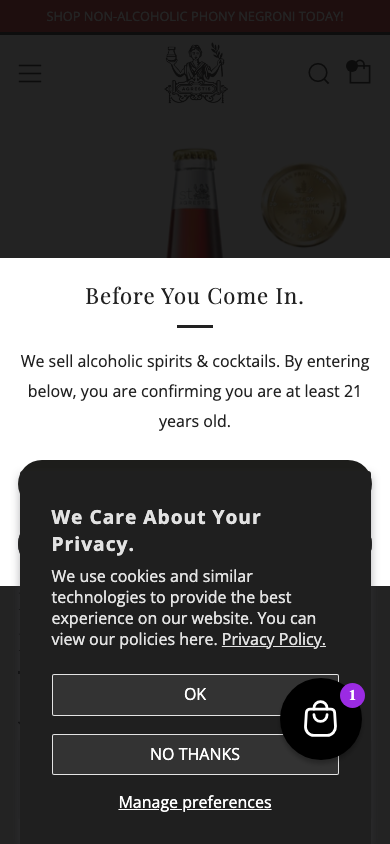
Current St. Agrestis mobile site
Now Two pop-ups before a single product, on the device that's 70% of traffic.
Redesign The product, price, and one button, all in thumb reach. Have a scroll and tap it (concept).

What's leaking now

A new phone visitor gets an age gate and a cookie pop-up stacked on top of each other before anything is even tappable. Get past those and there's a 16-item menu, a 2.8 MB hero image, and a checkout that asks for format, then pack size, then pushes an upsell drawer. On mobile that's roughly $23–45K a month in orders the store already paid to acquire and then lost.

What the redesign changes

We take the pop-ups out and put the product, price, and add-to-cart right at the top, with the button in thumb reach and the default pack already selected. It's the same brand on the same Shopify catalog underneath, so nothing about your setup changes, it just gets people from landing to checkout a lot faster.

A

It stays on Shopify.

A custom Online Store 2.0 theme. The design is fully bespoke, but Shopify still owns the catalog, inventory, and checkout, so your team merchandises from the same admin through editable sections, without waiting on us.

B

You see it in Figma before we build it.

I open a shared Figma workspace, you comment in it, we iterate there. Once it's approved we build it into the theme and ship through GitHub, so every change is versioned and a rollback is one click.

C

The agent layer is already live, and we built it.

The current site already exposes an agents.md, an agent-discovery sitemap, and an MCP endpoint, so AI shopping agents can read and transact with the catalog. That's our work, shipped months ago. The new site keeps it and builds on it.

Agentic commerce · live since Q1
03 / The same approach, on Franzia America's best-selling boxed wine

Ask an AI for the best boxed wine, and Franzia isn't on the list.

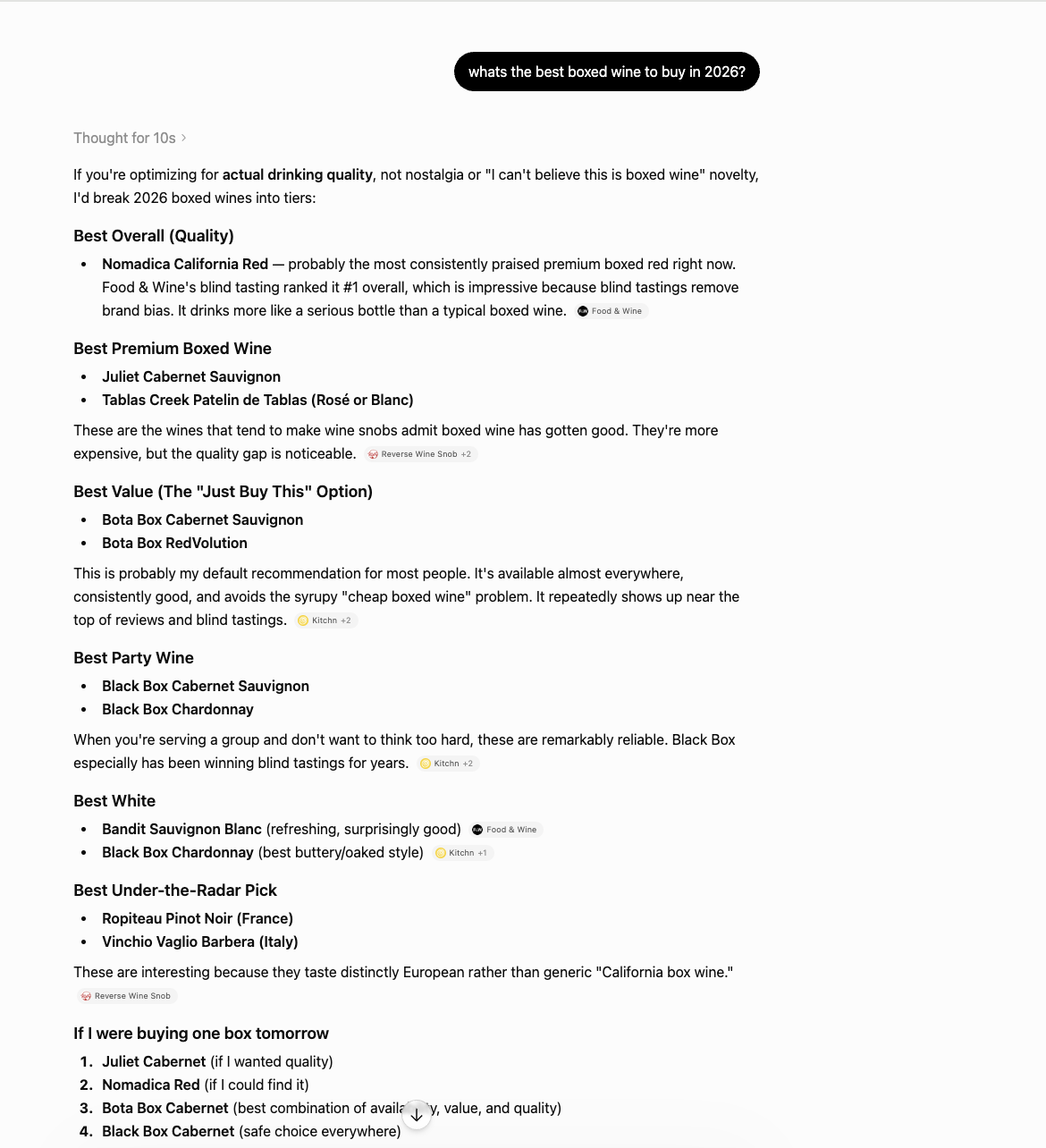
I asked ChatGPT for the best boxed wine to buy in 2026. Here's the answer.

ChatGPT · "what's the best boxed wine to buy in 2026?"June 2026
ChatGPT's answer: eight boxed-wine brands across seven tiers, none of them Franzia

What it actually recommends.

It names eight brands, Nomadica, Juliet, Tablas Creek, Bota Box, Black Box, Bandit, Ropiteau, and Vinchio Vaglio, sorted across seven tiers right down to a shortlist for the one box to buy tomorrow. The best-selling boxed wine in America doesn't show up in any of them.

Why it's missing.

You can see what the model's reading. It cites Food & Wine, Kitchn, Reverse Wine Snob, and a stack of blind tastings. Nomadica got the top spot off a Food & Wine blind tasting, and Black Box, in the answer's own words, has been winning blind tastings for years. It's all coverage Franzia isn't part of, and the one source every model leans on, Wikipedia, still calls Franzia "jug wine."

And it couldn't close the sale anyway.

Nothing an AI can read. There's no product schema on the wine pages, so no price, rating, or varietal a model can quote, just a title and a breadcrumb.
Nowhere to buy. Every page ends at "Find a Store," with no cart or checkout, so the sale goes to Instacart or Walmart and the data never comes back.

Which is the opening.

I looked at the rest of the shelf, and Bota Box dead-ends at a store locator too, with no product data either. Nobody in the category has done this work yet, so the first boxed wine an AI can both recommend and ring up basically gets the lane to itself, and Franzia has the volume and the name to be that one.

What we'd change.

There are two parts to it. First we get Franzia into the conversation, which is the AEO and editorial work that puts it in the reviews and blind-tasting roundups the models actually read, plus cleaning up the entity side so it stops reading as "jug wine." Then we make the pages themselves AI-ready, with product schema a model can quote and a real way to buy instead of a store locator. It's the same work we just did for St. Agrestis.

Something for the AI to read

Product, Offer, Review and Brand schema on every wine page, so a model has a real price, rating, and varietal to quote.

Somewhere to actually buy it

Price, ratings, and a way to buy on the page itself, with conversions tracked instead of a dead end at a store locator.

franzia.com/dark-red-blendConcept
A page a model can read and a buyer can actually buy from.

Looking forward to working together.

Signyl · ben@signylai.com